It’s no secret that AI has made its way into just about every portion of paid advertising strategy. In some ways, that can be a great thing, with the machines having access to many more data points that can oftentimes lead to better results than what we can do manually. They’re great at finding patterns in the user behaviors of our customers.
But one area that they’re not great at: positioning our businesses in the way we want to be. The AI algorithms can craft compelling messaging that speaks to our customers’ desires, but they’re not always great at making sure that the messaging is compatible with your brand voice and market position.
The solution: AI Brief. It’s a new tool announced by Google in May 2026 that aims to help advertisers leverage AI systems that can get better results, but with direct advertiser input to make sure the messaging Google uses passes the sniff test. Here’s the full rundown.
Contents
- What is AI Brief in Google Ads?
- Which Google Ads campaigns have AI Brief?
- Where will Google Ads AI Briefs be applied in campaigns?
- Which parts of Google Ads won’t be impacted by AI Brief?
- When will AI Brief roll out?
- Benefits of Google Ads AI Brief
- AI Brief potential limitations and drawbacks
- Tips for using AI Brief in Google Ads
What is AI Brief in Google Ads?
In the shortest terms, AI Brief is a new feature that lets advertisers provide context to Google’s AI to help give direction on the type of messaging to use, searches to match for, and audiences to engage with.
In the image below, you can see what this new input system looks like. You start by defining your ideal ads. This is a simple open text box for you to give directions in.
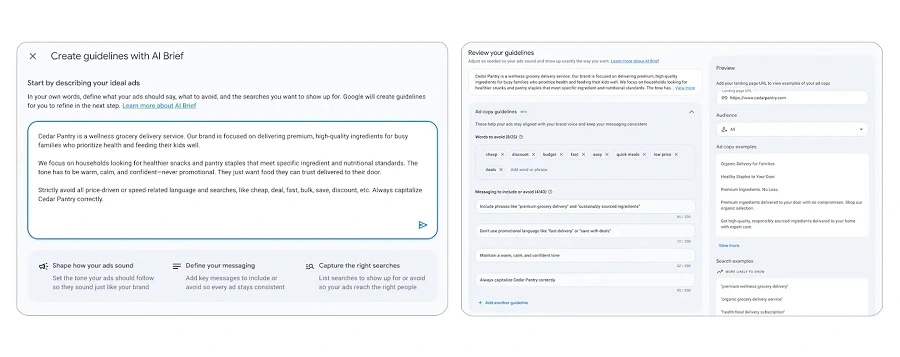
There are additional areas to help craft messaging. Specifically, you can add words to avoid, as well as longer messaging to include or exclude from messaging.
While the image doesn’t show it (and I haven’t seen this live in any of my accounts yet), you can also give direction on the queries your ads match to, as well as the audiences you serve for.
Which Google Ads campaigns have AI Brief?
This feature was announced for AI Max campaigns in Google Ads, but has since been expanded to include AI Max for Shopping, and will be rolling out to Performance Max as well.
Essentially, any area of the Google Ads platform that leverages the “asset optimization” feature is likely going to get access to the new AI Brief functionality.
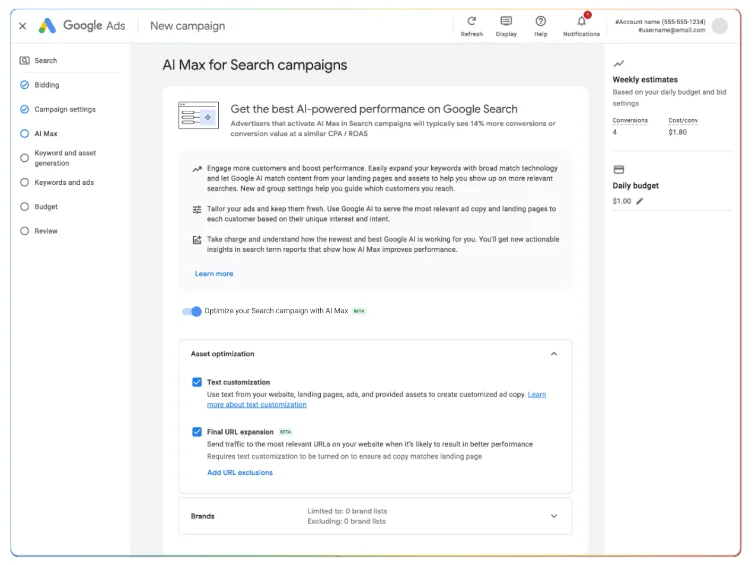
AI Max campaigns will now have an AI Brief option during the creation process.
Where will Google Ads AI Briefs be applied in campaigns?
AI Brief specifically impacts three areas in AI Max search campaigns:
- Messaging: Tell Google AI what it can and can’t say in assets (ad text) that it customizes for you.
- Matching: Provide guidelines for the types of queries you want to show for and those you want to avoid. This is more of a broad direction than keywords or negatives. Don’t say “Exclude ‘free,’ ‘cheap,’ ‘discount,’” etc. Instead, give broad directions like “We’re a premium brand and want to avoid all queries where someone might be looking for discounts or low-cost products”.
- Audience: Create a portrait or persona you want to target with your ads and have Google’s AI find users in line with that group rather than using specific audiences from their prebuilt library.
Which parts of Google Ads won’t be impacted by AI Brief?
While you are able to give direction on matching and audiences, AI Brief is not intended to be a replacement for keyword targeting, audience signals, Smart Bidding, or landing pages. It’s essentially just another layer of signals that can help Google get you the best results based on your account or campaign goals.
When will AI Brief roll out?
While Google hasn’t released a fixed rollout calendar, AI Brief will roll out in AI Max for Search campaigns (English-only to start) over the coming months before expanding to Performance Max and AI Max for Shopping campaigns. Any of your existing text guidelines will be migrated into AI Brief once the feature is activated in your account(s).
Once that rollout is complete (or close to it), AI Brief functionality will begin rolling out to Performance Max and AI Max for Shopping campaigns.
Benefits of Google Ads AI Brief
Ask any of us old-timers; we’ll tell you search behavior has changed quite a bit over the last 10 years. Searches are regularly longer and more conversational than they were in the past. Users are no longer trying to distill their query into the shortest amount of text they can, because the machines can understand their intent much better now. Google can now serve ads to people based on the intent signals it gathers from those queries.
Additionally, Google tends to have a decent handle on what messaging the user wants to see at that moment. The introduction of automated messaging helps businesses serve a compelling message to someone in the midst of a high-intent interaction with Google.
The problem really comes down to making sure that the compelling message Google serves in that high-intent moment is in line with your business. With AI Brief, you’re able to give direction to the AI exactly like you would with a creative agency or copywriter.
AI Brief potential limitations and drawbacks to be aware of
At this point, everything AI Brief has to offer probably sounds pretty good. No business is ever too disappointed when they’re able to make sure the brand messaging is followed while getting good results, right?
But that’s just one side of the situation. Here are some things to keep in mind with AI Brief:
- Garbage in, garbage out: It’s still on you to give good direction to AI Brief. Without clear direction, the system still might target the wrong users, leverage the wrong brand voice, and so on. Put in the effort for this area of the account to make sure you’re leveraging it fully.
- Guidance, not hard rules: The direction you give in the AI Brief is still just that: direction. The language you use here won’t categorically override certain bid decisions, auction choices, asset combinations, or matching to specific queries if Google thinks it can see results. If you need more firm rules, address those in your campaign settings.
- It only works for AI Max (and other highly-automated options): I don’t know about you, but I’ve tested AI Max for many of my accounts, and the results are….well, I later turned it off. Performance Max has a better track record for me, but it’s still on thin ice in some places. AI Brief isn’t a feature for regular Search campaigns. You must be opted into AI Max. If you’ve already tested this and didn’t see results (i.e., me), it might be worth another round of testing, but just be aware that AI Max is part of the deal you opt into with AI Brief.
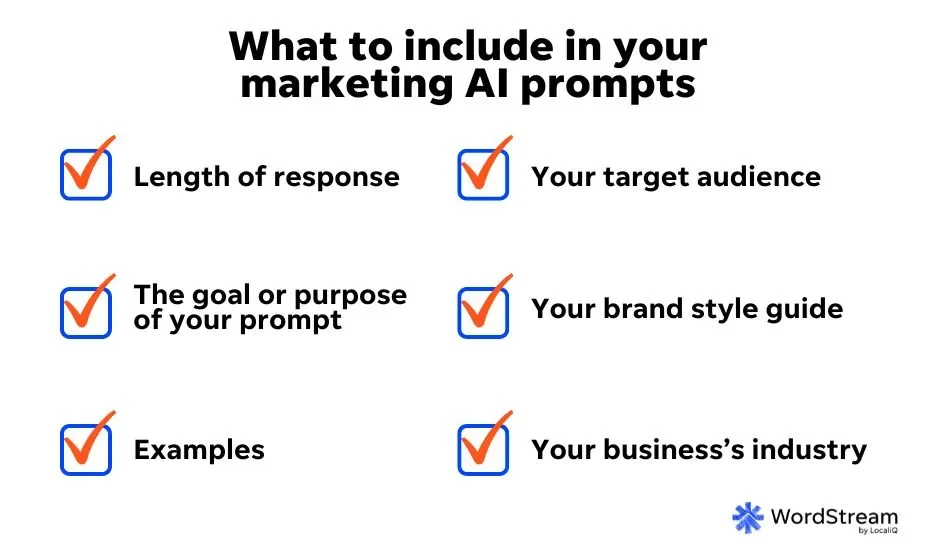
For best results, you should treat your AI Brief as you would any other AI prompt.
Tips for using AI Brief in Google Ads
Once AI Max is rolled out to your account, here are some things I think you should keep in mind when you begin to leverage it for the first time:
- Use natural language in your direction, but keep it clear. Don’t try to get too fancy with your direction or “game” the AI for one thing or another.
- Be clear about the messaging you want included or excluded.
- Highlight the differentiators between you and your competitors.
- Give a clear picture of who your target audience is based on the keywords you’re leveraging in that campaign.
- Review Google’s suggested assets and search queries before finishing up. If you notice something’s amiss, you can adjust your inputs to get what you’re looking for.
- This isn’t a set-it-and-forget-it tool. Regularly review your AI Brief if your business, audience, campaign strategy, or some other portion of the ecosystem changes.
How to turn AI Briefs into your next go-to Google Ads tool
It’s been said for a while that advertisers in Google Ads are slowly shifting from campaign managers to machine managers to make the campaigns work. AI is a part of every system in the platform, but AI Brief is the most direct example of this shift. Advertisers simply give direction, then lean on the machine to execute.
Again, it’s not a full solution, but it’s the first step in that direction. This can be a great tool for getting better results from AI Max campaigns, but it is also likely a skill advertisers are going to need to develop to see success in the future.
For more ways to run efficient, automated advertising campaigns on Google and beyond, see how our solutions can help!
The post Google AI Brief: Everything You Need to Know appeared first on WordStream.